Tag Archives: dressage for gaited horses

2015 Jennie Jackson Clinic

Jennifer Klitzke riding a gaited dressage school master
No better way to discover “the feeling of right” than by riding a gaited dressage school master.

By Jennifer Klitzke

Blooming trees and sunny daffodils, friendly southern folks, and lots of gaited dressage learning experiences to apply with my naturally gaited Walking horse Makana.

March 20-22, 2015 was my third Dressage as Applied to the Gaited Horse Clinic with Jennie Jackson. Only this time I traveled to White Stables near Knoxville, Tennessee instead of hosting a clinic in my state. I thoroughly enjoyed time with my gaited dressage mentor and an early spring with daffodils and flowering trees in full bloom, plus no snow. (Well, not until I returned home!)

Champagne WatchoutEn route to the clinic I had to stop by and visit the legendary naturally gaited dressage stallion Champagne Watchout. Still wearing his winter fuzzies, he stood handsome for a picture!

The first two days of the clinic were held in the spacious outdoor arena where Jennie taught riders the importance of teaching their horses lateral exercises such as pivot the fore and leg yield.

lateral exercises
It is easiest to teach lateral exercises to the gaited horses in hand before applying them from the saddle.

Both leg yield and pivot the fore are helpful in relaxing the horse’s back and break up pace to establish a natural four beat gait.  The pivot on the fore is a great exercise to teach riders the coordination of inside calf to outside indirect rein which relate with the horse’s inside hind leg as it steps beneath its body and neck, shoulder, and outside fore. Once each horse and rider understood these exercises in hand, they mounted up and applied the exercises from the saddle.

By day two every horse and rider were catching on wonderfully to these new exercises. Then Jennie proceeded to coach them to establish forwardness, rhythm, relaxation, and depth of stride in medium walk and gait. Each time the horse began to pace or stiffen, Jennie asked the rider to turn the horse into the fence and leg yield until the natural four beat gait returned.

Naturally gaited Champaign horse
Leg yield breaks up pace to restore a natural four beat gait.

The more advanced dressage riders worked on canter departs from a shoulder fore position, as well as breaking up stiffness at a flat walk (or trot) using shoulder in and haunches in. (I say “trot” because there were a few non-gaited horses at this clinic in addition to us gaited folk.)

This dressage rider brought her fiance's three-year-old TWH filly and got established in flat walk, running walk, rack and canter by day two!
This dressage rider brought her fiance’s three-year-old TWH filly and got established in flat walk, running walk, rack and canter by day two!

On the second day Jennie demonstrated canter and counter canter; showed the difference between flat walk and running walk; demonstrated how shoulder in, haunches in, shoulder out, and haunches out at a flat walk break up tension and stiffness within the horse to make them soft and supple; and she showed us ways to lengthen the gaited horse’s depth of stride.

Jennie Jackson demonstrates canter and romvere on a gaited horse
Contrary to popular belief, cantering the gaited horse actually improves the four beat gait while lateral exercises improve relaxation and suppleness.

Video: Jennie Jackson demonstrates cantering the gaited horse

Video: Jennie Jackson demonstrates how lateral exercises supple the gaited horse and improve depth of stride in the flat walk

The third day our group headed out to the trails to enjoy the beautiful 135 wooded acres surrounding White Stables.

trail ride
Gaited horses and trotting horses riding together on a trail ride—who said it can’t be done!

What a great group of people I met in Tennessee. I couldn’t help but giggle at your friendly Southern accents, yet ya’all kept insisting that I was the one with the Minnes-O-ta accent!

Jennie Jackson Clinic Photo Gallery»

White Stables

Thank you to White Stables for opening your beautiful facility to host the clinic. Thank you to Ronance for lending your exquisite gaited dressage school master to me, and thank you to Mary and Sydney for taking photos of me while I rode.

For Jennie Jackson’s Clinic schedule or to book a clinic in your area, connect with Jennie on Facebook at Jennie Jackson Dressage en Gaite.

Kris Blacklock and her naturally gaited Rocky Mountain horses

Naturally gaited versatility Champion Kris Blacklock
Kris Blacklock and her versatile naturally gaited Rocky Mountain horses prove that dressage is more than trot and the saddle you ride in!

By Jennifer Klitzke

Although we haven’t met in person, I simply LOVE the fun and enthusiasm Kris Blacklock has with her drop-dead gorgeous naturally gaited Rocky Mountain horses, Gambler’s Jackpot and Goodnight Beautiful.

Talk about versatility of the gaited horse! Kris and her Rockies enjoy Western, English, and trail dressage, groundwork, freestyle, obstacle trail challenges, equestrian drill team, eventing, working with cows, gymkhana, trail riding, and more! She attributes dressage to be the foundation for the variety of disciplines she enjoys.

Kris is a member of North American Western Dressage (which now recognizes Gaited Dressage affiliated with Friends of Sound Horses). She also heads up the Western Dressage of WI Facebook Group.

Kris believes dressage benefits ALL equines—including gaited breeds. She says, “I invite YOU to discover how dressage (Traditional, Gaited, Western, Trail, Therapeutic and Groundwork) prepares ALL horses and ALL riders through classical training of Rhythm, Relaxation, Connection, Impulsion, Straightness and Collection.”

Whether you connect with Kris via the online Western Dressage of WI Facebook Group or in person at one of the North American Western Dressage events this summer (in which I will be one of them), you’ll see her encouraging “horsemanship sportsmanship” with her motto: “learn, laugh, ride, have FUN individually and as a team and share your knowledge, skills and experiences with each other.”

I am so happy to see how others like Kris have discovered that dressage is more than trot and the saddle you ride in! Dressage improves a naturally gaited horse in so many ways beyond the four walls of an arena—and it is a blast, even for us older riders who still believe we are in our 20s!

Congratulations Kris and her Rocky Mountain horses Gambler’s Jackpot and Good Night Beautiful, 2014 North American Western Dressage Amateur Versatility Champion and Reserve Champion!

Kris Blacklock and Gamblers Jackpot 2014 NAWD Versatility Amatuer Reserve Champion
Kris Blacklock and Gamblers Jackpot 2014 NAWD Versatility Amateur Reserve Champion
Kris Blacklock and Good Night Beautiful 2014 NAWD Versatility Amatuer Champion
Kris Blacklock and Good Night Beautiful 2014 NAWD Versatility Amateur Champion

The Critical Student

the critical student

Since many teachers make up the breadth and depth of a student’s education, could it be the same for one’s riding studies? Here’s my story.

The Critical Student

By Jennifer Klitzke

The sound of my sneakers gripping the polished floor caught the attention of fellow students as I entered the classroom. Looking around for a place to sit, Professor Larson interrupts the glances, “If you want an “A” you’ll have to sit in the front row.” Giggling classmates lighten my apprehensive return to college after a 21-year break.

Professor Larson was teasing of course. I regathered my items and took a seat in the “A” row. I have an ambitious nature (and my peepers don’t see as good as they used to).

Professor Larson made it his mission to form critical students by encouraging each of us to listen, take notes, think through, and apply what is presented. That’s how learning is best retained.

I discovered that you don’t have to be in school to learn, but college put words to what I had already been doing as a student of dressage. For years I have been taking notes after each dressage lesson and clinic I’ve ridden at. I practice what I’ve been taught in efforts to form a new habit. I even take notes while watching instructional DVDs and while auditing clinics. I underline and scribble notes in the margins of dressage books I purchase. I think through the concepts presented. Then I try them out the next time I ride.

In fact, in his book, Reflections on Equitation Art, the late Nuno Oliviera wrote, “I know that I still have much to learn, and will go on learning until my dying day, not only my riding, but my studying, thinking deeply, and observing.”

For one of the greatest dressage masters of our time to feel there is still so much to learn through riding, studying, and thinking critically encourages me in my lifelong learning pursuits.

My favorite way to learn is through lessons, but there isn’t anyone in my area who teaches dressage, let alone dressage for the gaited horse, so between traveling clinicians with Jennie Jackson and others, my second most helpful way to learn is through video. Each week I set up my Pivo with my cell phone and record my ride. After each exercise, I stop and describe how it felt to the camera. Then when I replay the video, I can verify if what I see on screen matches what I felt from the saddle. I guess you could call it a form of self-help dressage for the gaited horse (and rider) instruction!

I became a student of dressage in 1988 with my first riding instructor. For 12 years she did a wonderful job coaching me from Training level through Second level competition with my Trakehner/Thoroughbred gelding. She taught me a solid foundation of the feeling of right and what to do when it felt wrong (at least from the German dressage paradigm).

Back then I felt like a traitor if I took lessons from anyone other than my instructor or dabbled with another training philosophy, so I became locked into only one view of riding.

Looking back, I think this was rather silly. Professor Larson wasn’t the only teacher who encompassed my college education. I learned from dozens of professors who collectively imparted diverse knowledge to form the breadth and depth of my study.

After 12 years of dressage lessons with my first instructor (for which I am grateful), much has changed in both our lives. I remarried and moved away. My instructor went to Seminary and is now an ordained Pastor leading a church (and still riding horses of course)!

In fact, in his book, Reflections on Equitation Art, the late Nuno Oliviera wrote, “By reading, riding, and meditating great results may be obtained if there is a true feeling for the horse, provided the rider’s seat is good, without following exactly all the details of any one method.”

Thankful for my years under my first dressage instructor’s mentorship, my curiosity and passion for learning didn’t stop when our paths met forks in the road. It actually freed me to try new philosophies beyond my German dressage foundation. I acquired my first smooth gaited horse and dressage for gaited horses with Jennie Jackson and Larry Whitesell; cross country and gymnastic jumping with Len Danielson; began trail riding; trail obstacles; endurance riding; orienteering; sorting cows and team penning. Then was introduced to natural horsemanship with Pat Parelli and the importance of groundwork. Began studying natural hoof trimming, and then the study of classical French dressage. All of these instructors, riding philosophies, and versatilities have added to the depth and breadth of my naturally gaited riding experience.

You see, I am open to humane ideas and activities that foster and build teamwork, trust, balance, relaxation, forward movement without rushing, lightness, and symmetry, as I work with my naturally gaited horses. To me learning goes beyond the knowledge of just one instructor and one training paradigm.

My favorite way to learn is through lessons, especially as I navigate uncharted territory and apply dressage with my head shaking, four beat flat walking smooth gaited horses. Between lessons, I sift through my treasure chest of notebooks, dressage books, videos and DVDs, and if I don’t find an answer, I Google it or search Youtube.

While I’m blessed with an abundance of online resources and much of it free, it can get tricky knowing which ideas to consider and which ones to discard. Often times one philosophy contradicts another. That’s when I become a critical student. I’ll listen to an idea, think it through. If I believe it has merit, I’ll try give it a try. Evaluate it, and if it helps my horse find balance, relaxation, and helps us build harmony, I will add it to my treasure chest. If not, I’ll pitch it. If I’m in question, I’ll ask my riding friends what they think and pick my instructor’s brain during my lesson time.

Trying out a new idea doesn’t replace everything I’ve learned up to that point. Nor does it mean that by embracing ideas from a new training philosophy or instructor means scrapping everything I’ve learned from another. I merely add workable ideas to my methods of getting to my final outcome—which is a work in progress.

In the end, my intention aims to bring about a harmonious partnership with my horse, moving together in balance and relaxation, bringing about the best quality smooth gaits and full range of motion, lightness of aids, consistent rhythm, and symmetry as it relates to the gaited horse.

You see, I’m passionate about learning and will always consider myself a student—into my grandma years and beyond.

Questions?

Let me know your thoughts by completing the form below.


Visit website: NaturallyGaitedHorse.com
Subscribe: Naturally Gaited youtube channel
Follow: facebook.com/naturallygaitedhorse

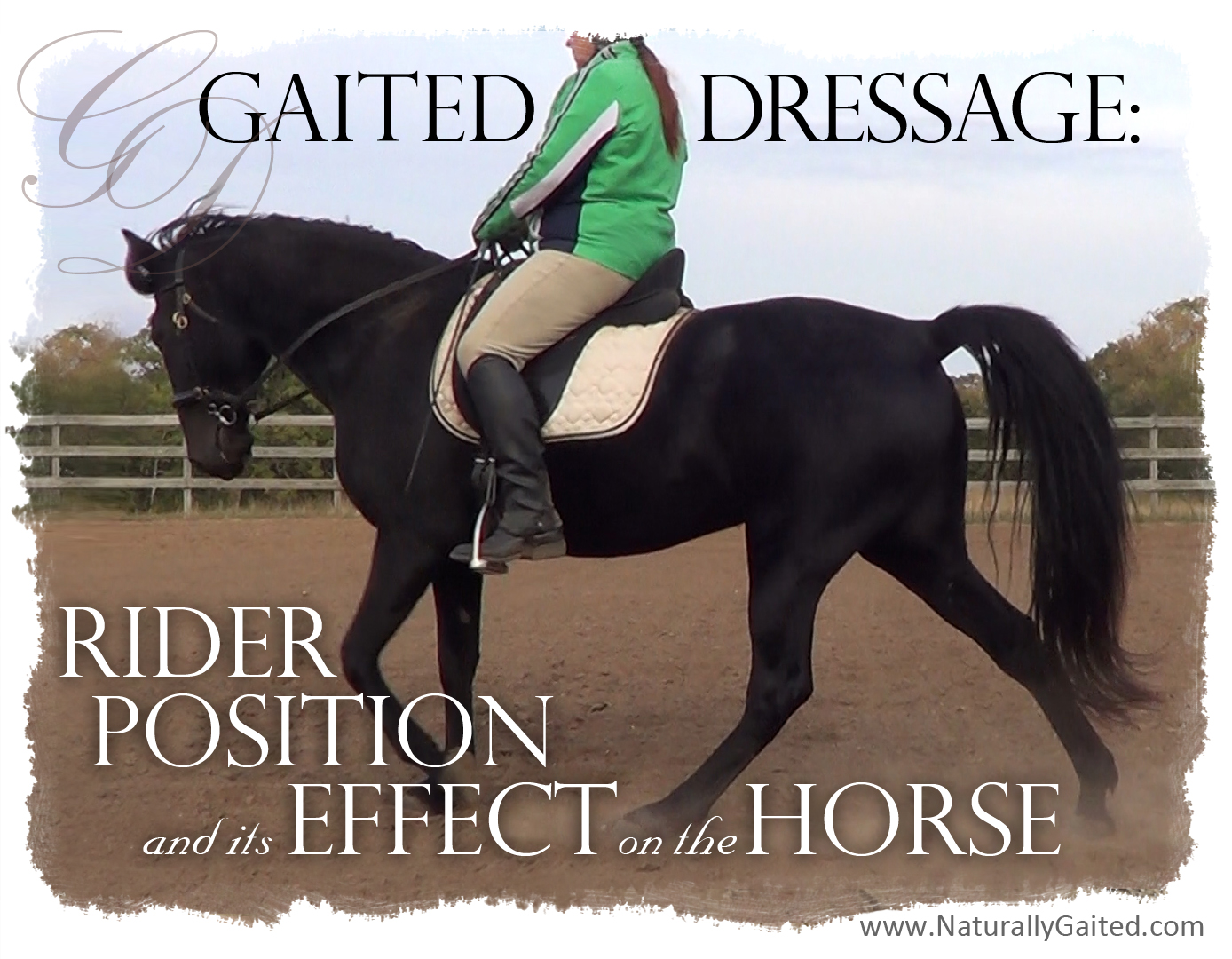
Rider Position and its Effect on the Gaited Horse

rider position and its effect on the gaited horse

Did you know that there is more than one rider position? Did you know that rider position has an effect on the horse and smooth gait? Did you know that rider position can place you in a more secure position to help you confidently ride through spooks?

Rider Position and its Effect on the Gaited Horse

By Jennifer Klitzke

Since 1988, I’ve taken hundreds of dressage lessons, ridden at dressage clinics, read many books, and watched dozens of dressage videos. When it comes to rider position, there are a variety of methods.

Comparing Rider Positions

The rider position I first learned teaches an ear, hip, and heel alignment and balance by loosely following the horse’s movement. This position focuses on growing tall with the upper body while stretching the legs long and pressing the heel down into the iron. It gives the rider a straight leg feeling. The rider’s seat focuses on the three seat bones. While riding, there is a feeling of leaning back with the upper body, especially at the sitting trot.

Jennifer Klitzke riding at a Mary Wanless Clinic
Jennifer Klitzke riding her Spanish Mustang at a
Mary Wanless Clinic and getting established in the
A,B,Cs of riding bio-mechanics.

I learned another rider position when I rode at a Mary Wanless rider bio-mechanics clinic. She teaches balance through stillness made through the isokinetic bearing down of the core muscles and sealing the thighs and knees against the saddle. The rider’s seat includes the knees, thighs and seat bones where the majority of the rider’s weight is held in thighs and not pressed down into the heel. Instead, the toe lightly rests in the iron. This rider position also teaches an ear, hip, heel alignment, but with a 90-degree bend at the knee between the hip and heel instead of the straight leg. Instead of a leaning back feeling, there is a pressing forward feeling from the sternum as if resisting someone’s push.

Mary’s theories have been developed through her education in physics, biomechanics, riding dressage through the upper levels, and studying the best dressage riders of her time. She’s coached top riders such as long-time student and successful Grand Prix rider Heather Blitz.

Mary has a knack for putting words to how talented dressage riders ride. Even though I have been a book and video student for decades, it wasn’t until experiencing this clinic where her rider position and biomechanics really clicked.

naturally gaited Tennessee walking horse flat walk

Eleven steps to a more secure rider position that benefits the horse and smooth gaits

  1. Stirrup length: Adjust the stirrups to a 90-degree bend in the knee. At first it might feel too short.
  2. External alignment: While sitting on the horse just behind the wither, align the ear, hip, and heel.
  3. Thigh and knee position: Then rotate the thighs inward so that the thighs and knees seal to the saddle. This helps distribute the rider’s weight along the horse’s back instead of resting on the spine. When the horse is comfortable, the horse moves smoother.
  4. Toe in iron: The toes lightly rest in the irons.
  5. Rotate tailbone: Next, rotate the tail bone forward as if drawing it between the thighs. This flattens the lower back.
  6. Position in motion: In the rider position, ask the horse to walk. In each walk step feel one hip slightly rotate forward with the horse’s movement and then the other.
  7. Bear down: While at a walk, add what Mary refers to as “bear down.” This engages the core and lowers the center of gravity for more stability in the saddle. Mary describes it as, “sucking in your stomach and pushing your guts against it.”
  8. Seat bones: Then become aware of the three seat bones and lower them evenly to the saddle.
  9. Breathing: Adding to bearing down and lowering the seat bones to the saddle, breath deep as if the lungs fill up the stomach.
  10. Resisting the push: Next, imagine someone pushing against your sternum as you resist the push. This further engages the core.
    Another concept is to imagine someone pushing against your hands as you hold the reins. This concept helps you riding forward with the horse instead hold the horse back with the hands.
  11. Awareness of sitting surface: Finally, become aware of the full sitting surface: the lowering of the core and seat bones closer to the saddle for stability, the knees and thighs lightly holding the rider’s body weight along the saddle.

Rider Position and its Effect on the Horse

While Mary teaches this rider position to those with non-gaited horses, I’ve found that this rider position has worked well with my naturally gaited horses. Each time I align my position, lower my core, and distribute my weight through my thighs, my horses immediately lift their back, wither and shoulder, and move more naturally forward without prompting on my part. And best of all, their gaits are smoother.

This riding position has shown me how my rider position directly affects my horse. When I am riding in alignment and correctly positioned, my horse need less fixing and my horses move more comfortably forward. Each time my old habits creep back, my horses let me know by dropping their back and getting tense which reminds me to reposition myself.

A Secure Rider Position

When comparing my former riding position to the one Mary taught me, Mary’s rider position is more stable and secure. I notice that the angle my knees and thighs have to the back of my seat offer more stability when compared to a straight leg. Plus, by lowering my center of gravity closer to the saddle while holding my knees and thighs lightly along the saddle provides more security than when my upper body grew tall. Each time I ride through an unexpected spook, Mary’s rider position keeps me in place which builds my confidence. When I have confidence, it is easier to be relaxed which helps my horse relax.

Yes, there is more than one way to ride a horse. After 25 years of riding one way, I’m sure glad that I gave Mary’s rider position a try. It has made me a more effective, aware and confident rider which has translated into becoming a more trusted leader to my horse.

Video: Naturally Gaited Flat walk and Canter

What are your thoughts? Please reach out and send me a message or stay connected by subscribing to the Naturally Gaited youtube channel and “like” us on facebook.com/naturallygaitedhorse.


Visit: mary-wanless.com for educational videos, published stories, books and DVDs. You can even become a cyber student and find where she is teaching world wide near you.

How to show gaited dressage without leaving home

Western Gaited Dressage

By Jennifer Klitzke

Love to give dressage a shot, but wouldn’t be caught dead riding in an English saddle? Long to show your gaited horse in dressage but there aren’t any shows in your area? Just want to get feedback from a professional as to where you are at in your dressage training with your gaited horse but have no interest in showing before a crowd? Have a desire to compete but can’t afford the cost of showing? Well, here’s super exciting news for you!

How to show gaited dressage without leaving home

Friends of Sound Horses (FOSH) and North American Western Dressage (NAWD) have recently formed an alliance partnership. Both organization hold common ground in fostering the mental and physical well being of horses for lifetime soundness. NAWD has developed a platform for Virtual Schooling Shows where you can record your dressage test from your own backyard. Then upload your video for critique by a professional judge where you’ll receive feedback on where you are at in your training. Here’s the exciting part: This Virtual Schooling Show platform has been expanded to include GAITED horses under a category “Gaits Wide Open.”

Last year, FOSH introduced a Gaited Dressage program for live showing where you submit copies of your tests at the end of the year for awards. In addition to the Traditional live show category, FOSH has expanded the Gaited Dressage program to include a “Virtual” category using the NAWD Virtual Schooling Show “Gaits Wide Open” platform.  The FOSH Gaited Dressage rules apply to both the Traditional and Virtual categories. Each category will be awarded separately, yet you may choose to participate in both. The FOSH Virtual Schooling Show “Gaits Wide Open”category is open to Western (and English) gaited dressage using any of the tests included in the FOSH Independent Judges Association Manual for Gaited Dressage (pdf). All Virtual Gaited Dressage tests will be judged by licensed IJA dressage judges.

This exciting collaboration between FOSH and NAWD allows for inclusive competition with other gaited horse and rider teams worldwide without ever leaving your backyard!


For more information about the FOSH Gaited Dressage Program, visit Friends of Sound Horses Gaited Dressage Program.

For more information about the NAWD Virtual Schooling Shows, visit North American Western Association Virtual Schooling Shows.