Did you know lateral exercises like the shoulder in and shoulder fore can break up a pace or step pace and develop a more even four beat smooth gait?
Lateral Exercises for the Gaited Horse to Improve Smooth Gaits
By Jennifer Klitzke
Lateral exercises at a slow collected walk help the naturally gaited horse develop balance.
When you hear the term lateral exercises, what comes to mind? Do you think of gaited horses? Many people first think of non-gaited horses and dressage. However, lateral exercises offer great benefits for the gaited horse, especially ones that tend to pace or step pace.
Lateral exercises such as the shoulder in, shoulder fore, haunches in, shoulder out and haunches out are diagonal foot sequence movements that can help break up the pace and step pace. This helps gaited horses have smoother gaits like flat walk and fox trot. Other benefits include improving balance to be less heavy on the forehand, coordination, flexibility, strength and communication between the horse and rider.
Speaking of rider, the lateral exercises such as shoulder in, hauches in, shoulder out, and haunches out are great for the rider to learn coordination of the rein, leg, seat and weight aids in timing with the horse’s movement.
For me, lateral exercises have improved the quality of the natural smooth gaits in both my Tennessee walking horse, Makana and grade fox trotting horse, Lady. Lateral exercises break up tension, strengthen muscles, improve communication between horse and rider, and have helped both horses become softer, rounder, more balanced and develop quality smooth gaits.
For me, it has been helpful to become aware of when each of the horse’s legs are in a cue able position and to apply an aid accordingly. It helps the horse understand the lateral exercise more clearly and find balance and relaxation and building greater trust.
Shoulder In and Haunches In
The shoulder in and haunches in are great exercises for the gaited horse, especially for horses that tend to pace and step pace like Tennessee walking horses. Why? Because these exercises have a diagonal foot fall that break up the lateral foot fall of the pace. Shoulder in and haunches in also develop balance, strength and flexibility to the horse.
The shoulder in and haunches in can be done on at a slow walk on a straight line or on a small circle as shown in the video clips below. It is important to do these exercises twice as much in the weaker direction to help the horse become straighter (ambidextrous). Over time the gaited horse can develop a smoother gait.
Opportunities for Naturally Gaited Horses to Show Dressage
By Jennifer Klitzke
If you live in the Northern climates like I do and don’t have the luxury of an indoor arena, I am sure you are excited for Springtime! Thinking back a few years ago, my husband and I had planted our vegetable garden by now. Today we are still waiting for the snow to melt!
Last weekend we had another blizzard dumping 20 inches of snow!
Thankfully, this week’s warmer temperatures have been melting the snow at rapid speeds. By the end of next week, I hope my arena will be ridable again [for video-making season.]
Okay, [three paragraphs] of commiserating. Think yourself very fortunate if you live in temperate regions. (I am envious.)
This weekend my naturally gaited Tennessee walking horse, Makana, and I had the wonderful opportunity to meet with a friend and her lovely naturally gaited mare. We had a wonderful time riding together in an indoor arena and talking about naturally smooth gaited training methods. For me and Makana, it was the first time we had ridden in months. I am so grateful!
Springtime got me thinking about the exciting opportunities available to us naturally gaited riders this riding season through Friends of Sound Horses (FOSH) and the North American Western Dressage Association (NAWD). This friendly collaboration has made it possible for naturally gaited horse riders to compete virtually in our own back yards (English or Western) through the Gaits Wide Open program.
For me, this is exciting, because, I don’t have to travel. I can show from home. All I need to do is record my rides (to the video requirements) and email the links after submitting the show application. Then I wait for the judge’s test results and comments. Plus, virtual shows are affordable!
Of course, there are the dressage shows you can travel to that are open to gaited horse entries.
In either case, whether virtual or on site, showing dressage provides feedback from a professional about your test. You’ll get written comments from the judge about how you navigated the test requirements, your riding position and use and timing off aids.
Drop me a Line
Let me know your thoughts. I’d love to hear about your naturally gaited journey. or if there is a video I could produce that would be useful to you.
Enjoy your smooth gaited journey!
Jennifer, Makana, Lady and Marvel
Questions?
Let me know your thoughts by completing the form below.
Did you know that the natural gaits [on cue] can include trot for the gaited horse?
It was just what I needed, to be back in the saddle after several months off due to cold temperatures, darkness, and icy footing. It warmed up above freezing today, so me and Makana, my 14-year-old naturally gaited Tennessee walking horse played in the snow.
Just how many natural gaits did we tinker with on cue? Well, there was the freewalk, medium walk, flat walk, running walk, fox trot, trot, (yes, trot) and canter.
Crazy as it may sound, the trot [on cue] has actually improved Makana’s flat walk! How’s that, you ask?
After trotting for five minutes, her flat walk becomes more engaged from behind with a head-banging nod. The trot makes her engage her hindquarters, lift her back, activate her shoulders and chest to raise her wither, and helps her develops better balance and rhythm.
How many of you have tinkered with trot on cue with your gaited horse? What differences have you noticed in the quality of your horse’s movement? I’d love to hear from you if you have. Drop me a line and share how trot has improved your naturally gaited horse.
Dressage helps the naturally gaited horse develop long striding pushing gaits and engaged carrying gaits that improve the former to form full range of motion.
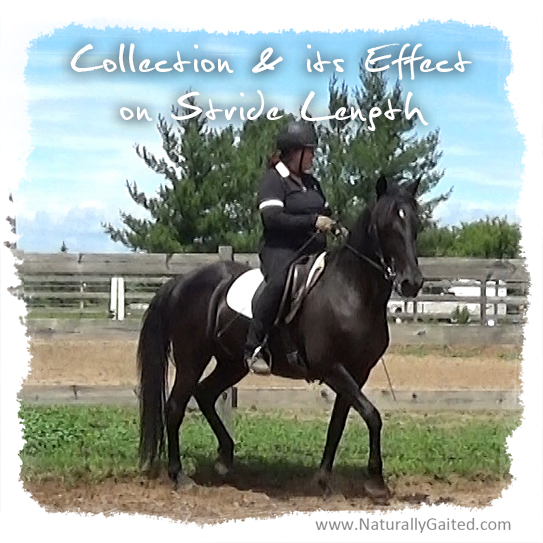
Collection and its Effect on Stride Length
By Jennifer Klitzke
If you are like me, training your naturally gaited horse using humane methods appeal to you. No mechanical devices. No artificial enhancements. No pads or heavy shoes. No harsh bits. No tight nosebands. No dominating methods. You like training your horse in a kinder way from a relaxed state to bring about harmony, balance, rhythm, connection, symmetry, engagement, and smoother gaits.
If you are like me, training your naturally gaited horse using humane methods appeal to you. No mechanical devices. No artificial enhancements. No pads or heavy shoes. No harsh bits. No tight nosebands. No dominating methods. You like training your horse in a kinder way from a relaxed state to bring about harmony, balance, rhythm, connection, symmetry, engagement, and smoother gaits.
My epiphany
For me, that’s why dressage has been my choice for my naturally gaited Tennessee Walking Horse, Makana. However, I hit a wall when we began to explore collection and introduce lateral exercises like shoulder in and haunches in. I had been expecting my horse to move with the long strides and head nod of flat walk while in collection.
Then I traveled to a dressage clinic with my naturally gaited horse. We worked in a posture of collection as we introduced the lateral exercises. The collected walk felt too slow. My horse’s stride length shortened. She didn’t have a head nod. After a few steps of shoulder in and haunches in, we released my horse into an extended posture with longer strides and a head nod.
The wall came tumbling down when I realized the carrying gaits of collection and pushing gaits of extension are two distinctly different postures of training. Both serve a role in developing the full range of motion. One does not replace the other, nor are they meant to be merged into one. This was an epiphany for me and a relief to my horse. I stopped expecting what is biomechanically impossible and embraced the carrying posture of collection to develop strength and balance with my naturally gaited Tennessee Walking Horse.
Just as the naturally gaited horse can learn to develop maximum stride length and head nod at the flat walk and running walk, the horse can learn the collected walk.
The collected walk doesn’t permanently shorten the stride, as if my horse is unable to perform long strides again. The stride length is temporarily shorter while in the posture of collection. Collection doesn’t replace long strides. Collection improves the quality of long strides. Pushing gaits and carrying gaits are two different postures that benefit the naturally gaited horse to develop the full range of motion and quality smooth gaits.
Here’s why.
Pushing vs carrying: Notice the difference between flat walk (pushing gait) and collected walk and half steps (carrying gaits). The pink line shows how much the horse uses the hind leg to push forward for stride length or carry for engagement. Collection and increasing engagement shorten the stride length. Dressage helps the naturally gaited horse develop long striding pushing gaits and engaged carrying gaits that improve the former to form full range of motion.
The collected walk
A collected walk is a carrying gait that develops strength. During a collected walk, the hind leg doesn’t push from behind the tail. Rather the hind quarters carry more weight. Without the hind leg pushing from behind the tail, the stride length becomes shorter because the horse’s four legs carry the body mass upward and forward. In the collected walk the horse bends its hindquarter joints and engages its abdominal muscles to lift its back. The horse also engages the chest muscles to lift the shoulders, wither, head and neck. The horse moves with more balance, poise and elegance. The collected walk also has a much slower tempo than the flat walk with little to no head and neck nod.
Training through the levels of dressage doesn’t mean that the collected gaits replace the big, long striding gaits. Rather, the horse develops a full range of motion: the long striding, scopey ground covering pushing gaits as well as the balanced, light, engaged and elegant carrying gaits of collection. Switching from one posture to the other is as simple as applying the cues.
The carrying gaits of collection along with lateral exercises produces balance, suppleness, and strength which in turn improve the quality of the pushing gaits as the flat walk and running walk.
I own and train my naturally gaited Tennessee Walking Horse, Makana and have shown her successfully at rail class breed shows. Developing big strides with a head nod is highly prized. Dressage and rail class are different in the way dressage introduces the collected walk and lateral movements to develop and improve the full range of motion.
While natural smooth gaits like the running walk “push” from the hind legs to create big strides, collected gaits “carry” from the hindquarters to produce balance and engagement which in turn improve the quality of the pushing gaits.
For the rail class competitor, the thought of slower, shorter strides, with little to no head nod may seem pointless. Yet teaching the naturally gaited horse the collected walk and lateral exercises like shoulder in and haunches in, counted walk, half steps and piaffe improve balance and engagement, which in turn improve the quality of the flat walk and running walk. These collected exercises use different muscles than the long striding pushing gaits.
As a dressage rider, I’ve labored to develop a big striding, head nodding flat walk and running walk for rail class events. Then I began schooling Second Level lateral exercises like the shoulder in and haunches in. I tried REAL hard to maintain the same length of stride and head nod when introducing collection and lateral exercises. Then I realized the flat walk and the collected walk are not the same posture. Lateral exercises are developed best at a collected walk.
The collected walk means SLOWING down and encouraging the horse to carry its body mass instead of pushing it from behind. This shortens the stride length for lateral exercises to improve balance, engagement, softness, and strength to further develop the horse’s symmetry, strength and flexibility.
While applying dressage with my naturally gaited Tennessee Walking Horse, I realized the demand for maximum length of stride in the collected walk isn’t realistic. Dressage lessons have confirmed this. Carrying gaits and pushing gaits produce different results. Working in the slower, engaged collected gaits with shorter stride and no head nod builds balance and strength which then improve the quality of the pushing gaits of flat walk and running walk with maximum length of stride and head nod.
Engagement and disengagement
The late Jean-Claude Racinet, a classical French dressage master of Baucher’s theories describes engagement and disengagement in a horse’s stride. He described engagement as the amount of stride under the horse’s body mass and disengagement as the amount of stride length behind the horse’s tail that pushes. In addition, the horse’s head and neck become still in the “collected” four-beat gait of walk.
For the Tennessee Walking Horse, the flat walk and running walk both seek to reach a maximum length of stride. This stride length consists of the distance from the foot beneath the body mass (engagement) and the foot pushing behind the tail (disengagement) along with the head and neck nod with each step.
The biomechanics of a collected walk produce a different effect than the flat walk. Both are needed to develop full range of motion and quality smooth gaits.
Yes, I want a maximum stride length and a pronounced head nod while riding the flat walk and running walk. Yet it is not realistic to expect these qualities from a collected walk. For me, this was a light bulb moment. I realized that I needed to change my expectations about stride length and head nod at a collected walk.
Shoulder in
Working in a slow, collected walk through shoulder in, haunches in, and half pass doesn’t mean replacing the flat walk and running walk. It just means I don’t combine the expectation of big strides and a head nod to the collected walk. The collected walk is just one more posture I develop to help my naturally gaited horse more balanced and athletic.
The collected walk has helped my naturally gaited Tennessee walking horse find balance. The tempo is slow and deliberate enough for her to learn lateral exercises. These exercises develop balance, strength, flexibility, and suppleness. After we apply moments of shoulder in and haunches in at a collected walk, we transition to a deep striding, head shaking flat walk in a neck extension and WOW! These transitions between strength training and stretching have improved her range of motion and quality of flat walk and running walk!
Neck extension at a flat walk allows the horse in a maximum stretch from nose to tail.
If you’ve ever seen the DVD of classical French dressage master Philippe Karl training High Noon, you’ll see how he trains his horse like he would play an accordion. He works his horse in a long and low frame for a few strides and then gathers the horse up for more collection and engagement in lateral exercises and then releases the horse to more strides of a long and low frame. This is what is known as gymnasticizing the horse to develop its full range of motion: pushing and carrying gaits.
I believe our naturally gaited horses benefit by developing full range of motion: From maximum length of stride and stretching at a flat walk and running walk to slower, engaged, balanced steps in a strengthening posture like a collected walk, and to lateral exercises to improve flexibility, suppleness, and symmetry. Dressage improves the quality of natural smooth gaits.
Applying transitions between the collected walk and moments of an expressive flat walk have been the perfect recipe for me and my naturally gaited walking horse Makana.
Dressage improves quality smooth gait over time. Makana at the age of 19.
Questions?
Let me know your thoughts by completing the form below.
Coming from the traditional trotting horse dressage camp to gaited dressage, nothing sounded more foreign to me than desirable attributes as ear flopping and teeth clicking.
What I have discovered since I began my gaited dressage journey in 2010 with my naturally gaited Tennessee Walking Horse mare, Makana is that it’s not so much the actual ear flopping and teeth clicking that’s important as what these attributes represent: relaxation and rhythm. Both relaxation and rhythm are what we seek in good dressage training whether riding a gaited or trotting breed. Along with this is relaxation of the jaw.
In breeds like the Tennessee Walking Horse, Missouri Foxtrotter and others that offer a natural and even four-beat gait, such as the flat walk and running walk, the horse will begin to click their teeth with each head nod in rhythm with the hind leg steps as the horse settles into relaxation of the jaw. Along with this relaxation, the horse may also begin to flop its ears with each head nod up and down.
This is something that doesn’t happen with trotting horses because the horse’s head and neck remain stationary in the trot. And when the trotting horse walks, it is too slow to produce the head nod that produces the same teeth clicking and ear flop seen in the flat walk and running walk.
Now, it is important to recognize the sounds: teeth clicking and the grinding of teeth are not the same things. In fact, they are on the opposite spectrum. If a horse is grinding their teeth, it is because the horse is tense and unhappy, not relaxed. The source for the grinding of teeth may be a tight fitting nose band, ill-fitting saddle or bit, or teeth that need to be looked at by a veterinarian or equine dentist.
In any case, the video below will provide the sound of teeth clicking as a result of relaxation and a happy mouth. (And yes, it is possible to train your naturally gaited horse to do a four-beat gait on a loose rein, barefoot, and in a mild snaffle bit.)
Video: Teeth Clicking Flat Walk in the Tennessee Walking Horse
Contains information related to marketing campaigns of the user. These are shared with Google AdWords / Google Ads when the Google Ads and Google Analytics accounts are linked together.
90 days
__utma
ID used to identify users and sessions
2 years after last activity
__utmt
Used to monitor number of Google Analytics server requests
10 minutes
__utmb
Used to distinguish new sessions and visits. This cookie is set when the GA.js javascript library is loaded and there is no existing __utmb cookie. The cookie is updated every time data is sent to the Google Analytics server.
30 minutes after last activity
__utmc
Used only with old Urchin versions of Google Analytics and not with GA.js. Was used to distinguish between new sessions and visits at the end of a session.
End of session (browser)
__utmz
Contains information about the traffic source or campaign that directed user to the website. The cookie is set when the GA.js javascript is loaded and updated when data is sent to the Google Anaytics server
6 months after last activity
__utmv
Contains custom information set by the web developer via the _setCustomVar method in Google Analytics. This cookie is updated every time new data is sent to the Google Analytics server.
2 years after last activity
__utmx
Used to determine whether a user is included in an A / B or Multivariate test.
18 months
_ga
ID used to identify users
2 years
_gali
Used by Google Analytics to determine which links on a page are being clicked
30 seconds
_ga_
ID used to identify users
2 years
_gid
ID used to identify users for 24 hours after last activity
24 hours
_gat
Used to monitor number of Google Analytics server requests when using Google Tag Manager
1 minute
Marketing cookies are used to follow visitors to websites. The intention is to show ads that are relevant and engaging to the individual user.
A video-sharing platform for users to upload, view, and share videos across various genres and topics.
Registers a unique ID on mobile devices to enable tracking based on geographical GPS location.
1 day
VISITOR_INFO1_LIVE
Tries to estimate the users' bandwidth on pages with integrated YouTube videos. Also used for marketing
179 days
PREF
This cookie stores your preferences and other information, in particular preferred language, how many search results you wish to be shown on your page, and whether or not you wish to have Google’s SafeSearch filter turned on.
10 years from set/ update
YSC
Registers a unique ID to keep statistics of what videos from YouTube the user has seen.
Session
DEVICE_INFO
Used to detect if the visitor has accepted the marketing category in the cookie banner. This cookie is necessary for GDPR-compliance of the website.
179 days
LOGIN_INFO
This cookie is used to play YouTube videos embedded on the website.



You must be logged in to post a comment.